2026-09-18
Chain link wire mesh is one of the most widely used fencing materials for residential, commercial, agricultural, industrial, and infrastructure applications. It has a simple appearance, but producing consistent chain link mesh requires control over wire diameter, mesh opening, weaving tension, surface treatment, roll dimensions, and packaging.
So, how is chain link wire mesh made?
The basic manufacturing process includes wire preparation, wire drawing, surface treatment when required, chain link weaving, mesh sizing, edge finishing, inspection, and packaging. The exact process varies depending on whether the finished mesh is galvanized, PVC coated, or manufactured from another wire material.
For distributors, contractors, and project buyers, understanding the manufacturing process can also make it easier to compare suppliers and identify important quality differences.
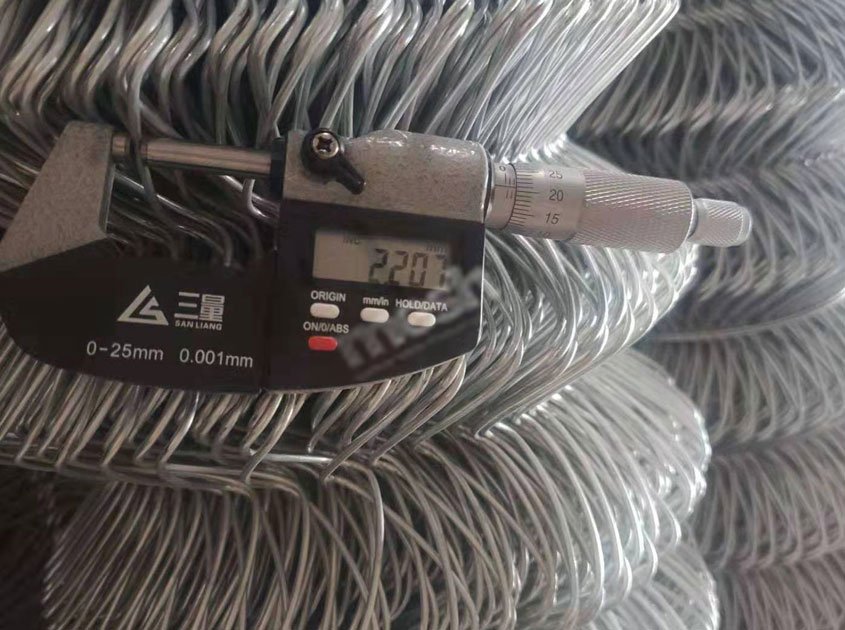
What Is Chain Link Wire Mesh?
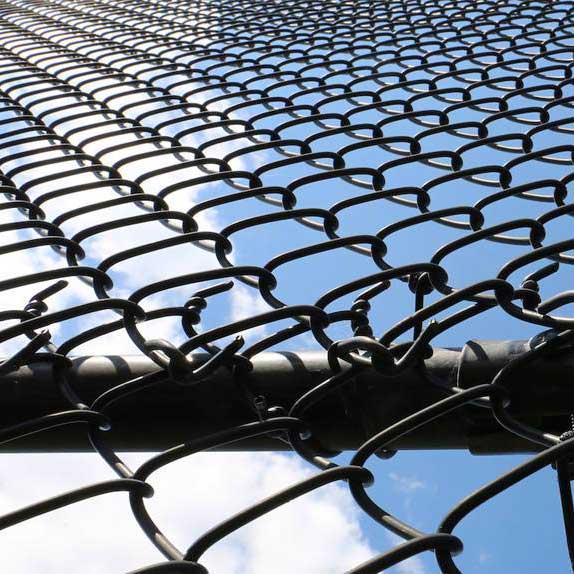
Chain link wire mesh is a woven wire mesh made by forming inpidual wires into a continuous diamond-shaped pattern. Unlike welded wire mesh, where wires are joined at their intersections, chain link mesh is produced by mechanically interweaving and forming the wire.
Common names include:
Chain link wire mesh
Chain link mesh
Chain link fencing
Diamond mesh
Diamond wire mesh
Cyclone fence mesh
Wire netting
The finished mesh is normally supplied in rolls. Depending on the application, it may be combined with line posts, terminal posts, top rails, tension wires, fittings, gates, and other components to create a complete chain link fence system.
Chain Link Wire Mesh Manufacturing Process
Although production equipment differs between manufacturers, a typical chain link wire mesh production line follows these main stages:
Steel wire → Wire preparation → Wire drawing → Surface treatment → Chain link weaving → Mesh sizing → Edge finishing → Inspection → Roll forming → Packaging
Let's look at each step.
1. Selecting the Wire Material
The first step is selecting suitable wire according to the required specification.
For standard chain link fencing, manufacturers commonly use low-carbon steel wire. Depending on the product, the wire may be:
Galvanized steel wire
PVC coated galvanized wire
PVC coated steel wire
Black annealed wire
Stainless steel wire for specialized applications
For standard construction and fencing projects, galvanized steel wire is particularly common because the zinc coating provides corrosion protection.
The required wire material depends on the application, environment, mesh specification, and buyer's project requirements.
For example, a general temporary fence does not necessarily require the same material specification as a permanent fence in a humid or coastal environment.
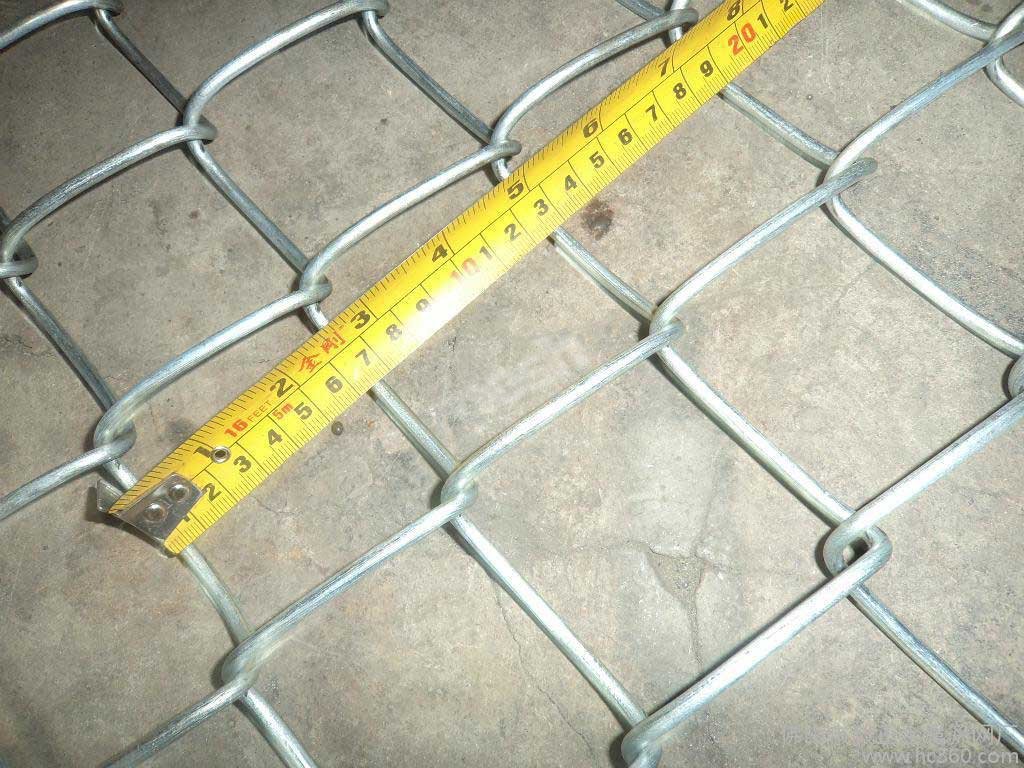
2. Wire Drawing and Diameter Control
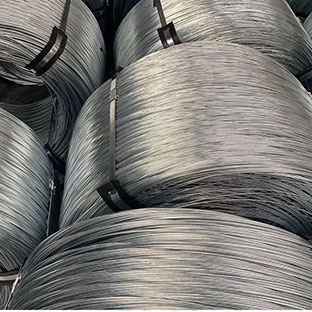
Steel wire may need to pass through a wire drawing process to achieve the required diameter.
Wire drawing reduces the diameter of the incoming wire by pulling it through specially designed dies. This process can improve dimensional consistency and prepare the wire for the weaving machine.
The final wire diameter is important because it affects:
Mesh strength
Mesh weight
Flexibility
Cutting resistance
Roll weight
Material cost
Finished fence performance
For example, chain link mesh may be specified using wire diameters such as approximately 2.0 mm, 2.5 mm, 3.0 mm, 3.5 mm, or 4.0 mm, depending on the application.
The actual specification should always be confirmed by diameter in millimeters or inches rather than relying only on gauge numbers, because gauge systems can vary.
3. Galvanizing or Preparing the Wire
If galvanized chain link mesh is being manufactured, the steel wire needs a zinc coating for corrosion protection.
There are two common approaches in chain link production:
Galvanized Before Weaving
The wire is galvanized first and then woven into chain link mesh.
This production method can provide a uniform coated wire surface and is commonly used for certain chain link specifications.
Galvanized After Weaving
The chain link mesh is woven first and then galvanized.
This method allows the finished woven mesh to receive the zinc coating after forming.
The choice between these processes can affect coating coverage, appearance, and cost. Buyers should therefore ask suppliers which galvanizing process is being used rather than simply specifying "galvanized chain link."
For projects with specific corrosion-protection requirements, buyers may also request information about zinc coating weight or thickness.
4. Feeding the Wire into the Chain Link Machine
After the wire is prepared, it is fed into a chain link weaving machine.
This is the stage where straight wire is transformed into the characteristic diamond pattern.
The machine controls the movement and forming of the wire to create repeated diamond-shaped openings. Production speed and machine settings need to remain stable to maintain consistent mesh dimensions throughout the roll.
5. Forming the Diamond Mesh
The wire is mechanically bent and interlocked to create continuous diamond-shaped openings.
The size of the diamond is determined by the machine settings and forming process.
Common chain link mesh openings include:
1 inch
1-1/2 inches
2 inches
2-1/4 inches
2-3/8 inches
2-1/2 inches
3 inches
4 inches
The actual available sizes depend on the manufacturer's equipment and product range.
A smaller opening generally creates a denser mesh, while a larger opening uses less wire per square meter for the same wire diameter.
For fencing applications, mesh opening and wire diameter should always be considered together.
A buyer should not compare two chain link products only by their mesh opening.
6. Controlling Mesh Width and Length
After the diamond pattern is formed, the production equipment controls the finished width.
Chain link mesh can be manufactured in different widths according to project requirements.
Common applications may require:
1.0 m width
1.2 m width
1.5 m width
1.8 m width
2.0 m width
2.4 m width
3.0 m width
Custom widths may also be possible depending on the machine and order quantity.
Roll length is another important specification. A buyer may request standard roll lengths or customized lengths based on installation requirements and container-loading considerations.
7. Finishing the Mesh Edges
The edges of chain link mesh are normally finished in one of several configurations.
Common options include:
Knuckled Edge
The wire ends are bent back into a relatively closed configuration.
Twisted Edge
The wire ends are twisted together to form a more secure edge.
The appropriate edge style depends on the buyer's requirements, local market standards, and intended application.
For large projects, it is useful to confirm the edge specification before production because edge finishing can affect installation and handling.
8. PVC Coating When Required
For PVC coated chain link mesh, the manufacturing process includes an additional coating stage.
The underlying steel wire may first be galvanized and then covered with PVC or another polymer coating.
PVC coating can provide:
Additional protection against the environment
A colored exterior
A smoother visual appearance
Additional separation between the steel core and surrounding environment
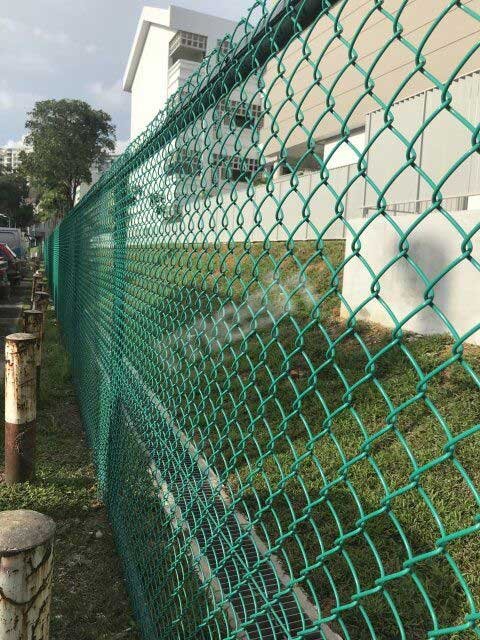
Common colors include green, black, and other project-specific colors.
For PVC coated chain link, buyers should clarify whether the quoted wire diameter refers to the steel core diameter or the finished diameter including the coating.
For example:
2.5 mm steel wire + PVC coating
is not necessarily equivalent to:
2.5 mm finished PVC-coated wire
This small detail can create significant differences when comparing quotations.
9. Quality Inspection During Production
Quality control should not begin only after the entire order has been manufactured.
A professional production process normally includes inspection at different stages.
Important inspection points include:
Wire Diameter
The steel wire should meet the agreed diameter tolerance.
Mesh Opening
The diamond opening should remain consistent throughout the roll.
Mesh Width
The finished width should correspond to the purchase specification.
Surface Coating
For galvanized products, the zinc coating should meet the agreed specification.
For PVC coated products, the coating should be reasonably uniform and free from obvious defects.
Weaving Quality
The mesh should have consistent interlocking and should not contain obvious broken wires, loose sections, or irregular forming.
Roll Length and Weight
The supplier should control roll dimensions and, where relevant, verify weight against the agreed specification.
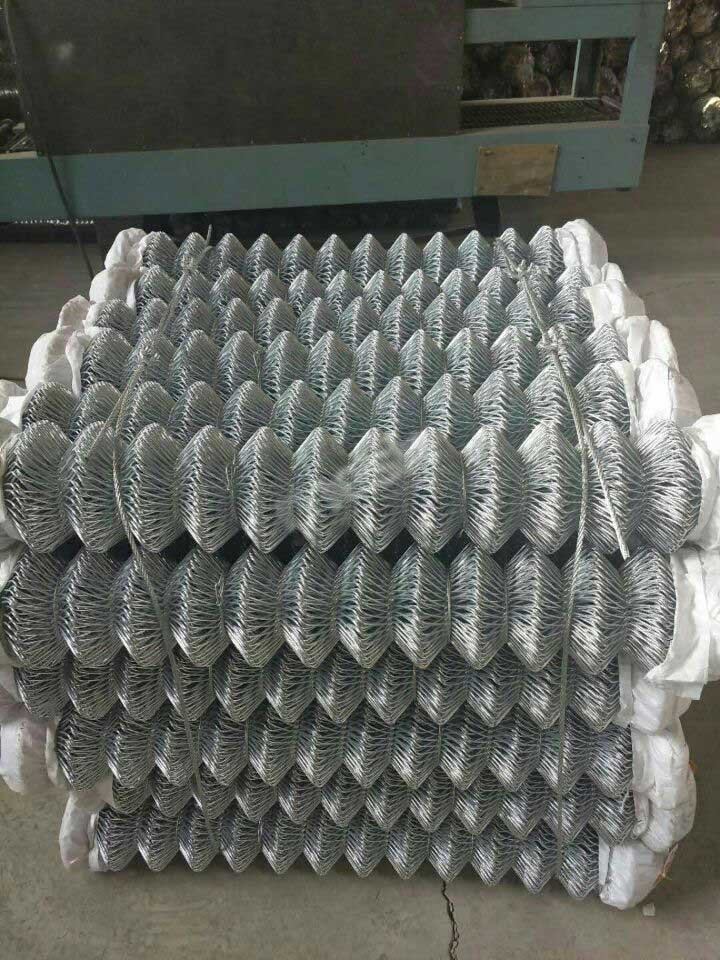
10. Rolling and Packaging
After production and inspection, the chain link mesh is formed into rolls.
Packaging depends on the product and transportation method.
Common packaging methods include:
Plastic film
Woven bags
Waterproof paper
Plastic film plus woven bag
Palletized packaging for selected specifications
For export orders, packaging should protect the mesh from moisture, dirt, deformation, and handling damage during transportation.
Roll diameter and package dimensions are also important because they influence container utilization.
For large-volume orders, a supplier may calculate the loading arrangement before production to improve container space utilization.
What Determines the Quality of Chain Link Wire Mesh?
Manufacturing equipment is only one part of the final product quality.
Several specifications should be considered together.
Specification Why It Matters
Wire diameter Affects strength, weight, and cost
Mesh opening Determines the size of the diamond openings
Wire material Influences corrosion resistance and application
Zinc coating Important for galvanized products
PVC coating Adds color and an additional protective layer
Mesh width Must match fence height or project requirements
Roll length Affects installation and material planning
Edge type Influences handling and installation
Weaving consistency Affects appearance and dimensional uniformity
Packaging Protects the product during transportation
This is why comparing chain link mesh only by the price per roll can be misleading.
A lower quotation may use a smaller wire diameter, lighter coating, shorter roll length, or different material specification.
Galvanized vs PVC Coated Chain Link Manufacturing
The basic weaving process is similar, but the surface treatment is different.
Feature Galvanized Chain Link PVC Coated Chain Link
Steel core Yes Yes
Zinc protection Yes Often used underneath PVC
PVC layer No Yes
Color options Metallic gray Green, black and other colors
Appearance Traditional metallic finish More uniform colored finish
Typical use General fencing Decorative, residential and selected outdoor applications
Specification focus Wire diameter and zinc coating Core diameter, coating thickness and color
The correct choice depends on the environment, project requirements, appearance, budget, and expected maintenance conditions.
How Do Manufacturers Control Chain Link Mesh Quality?
For distributors and contractors, several quality-control questions are worth asking before placing an order.
A reliable supplier should be able to confirm:
What steel wire material is used?
What is the actual wire diameter?
Is the diameter measured before or after PVC coating?
What mesh opening is being supplied?
Is the wire galvanized before or after weaving?
What is the zinc coating specification?
What edge type is used?
What roll width and length are available?
How is the mesh inspected?
How will the rolls be packaged for export?
For larger projects, buyers can also request product samples, inspection reports, or third-party inspection arrangements when appropriate.
What Should You Specify When Buying Chain Link Wire Mesh?
Instead of simply asking a supplier:
"Please quote chain link fence."
It is better to provide a complete specification.
For example:
Product: Galvanized chain link wire mesh
Mesh opening: 50 × 50 mm
Wire diameter: 3.0 mm
Width: 2.0 m
Roll length: 25 m
Edge: Knuckled and twisted
Surface: Galvanized
Quantity: 1 × 40HQ container
If you require PVC coating, add the following:
Steel core diameter: 3.0 mm
PVC coated finished diameter: To be confirmed
Color: Green
Coating: PVC coated galvanized wire
A detailed inquiry makes supplier quotations much easier to compare.
Chain Link Wire Mesh Manufacturing in China
China is one of the major manufacturing and export bases for chain link wire mesh and fencing products.
In particular, Anping, Hebei, is widely known as an important wire mesh production center. Manufacturers in the region produce chain link mesh alongside welded wire mesh, hexagonal wire mesh, galvanized wire, fencing systems, and other wire products.
For international buyers, purchasing directly from a factory can provide more flexibility in:
Mesh opening
Wire diameter
Roll width
Roll length
Galvanizing specifications
PVC coating
Packaging
Container loading
Fence accessories
OEM requirements
However, "factory-direct" should not be the only purchasing criterion. Buyers should compare the actual product specifications, quality-control procedures, production capability, communication, packaging, and export experience.
Common Applications of Chain Link Wire Mesh
Because the manufacturing process is relatively efficient and the product is flexible, chain link mesh is used in many sectors.
Residential Fencing
Chain link fencing is widely used around homes, gardens, yards, and residential properties.
Industrial Perimeters
Factories, warehouses, workshops, and storage facilities may use chain link fencing to establish property boundaries.
Sports Facilities
Chain link mesh can be used around tennis courts, sports fields, playgrounds, and recreational areas.
Agriculture
Farmers may use chain link mesh for animal enclosures, poultry areas, gardens, and general property fencing.
Construction Sites
Temporary and permanent site boundaries can be constructed using chain link mesh and suitable posts.
Infrastructure
Chain link fencing may also be used around utility facilities, transportation infrastructure, and other controlled areas.
Chain Link Mesh vs Welded Wire Mesh
The manufacturing method is one of the biggest differences between these two products.
Chain link mesh is woven and produces a flexible diamond-shaped structure.
Welded wire mesh is made by arranging wires in a grid and welding the intersections.
As a result, chain link mesh is often preferred when flexibility, economical fencing, and roll installation are important.
Welded wire mesh may be preferred when a rigid panel or rectangular grid structure is required.
Neither manufacturing method is universally suitable for every project. The right choice depends on the required structure, installation method, opening size, appearance, and application.
Frequently Asked Questions
Is chain link mesh woven or welded?
Chain link mesh is woven rather than welded. Inpidual wires are mechanically formed and interlocked into a continuous diamond pattern.
What wire is used to make chain link fencing?
Low-carbon steel wire is commonly used. Depending on the product, it may be galvanized, PVC coated, or manufactured from another specified material such as stainless steel.
How is galvanized chain link mesh made?
Galvanized chain link mesh can be manufactured using galvanized wire or by galvanizing the woven mesh, depending on the production method. The specific process should be confirmed with the manufacturer.
What determines chain link mesh strength?
Wire diameter, steel properties, mesh opening, weaving quality, coating, and the overall fence installation system all influence performance.
Can chain link mesh be customized?
Yes. Depending on the manufacturer's equipment and order quantity, buyers may be able to customize mesh opening, wire diameter, width, roll length, surface treatment, color, edge configuration, and packaging.
How do I compare chain link mesh quotations?
Compare the complete specification rather than the price alone. Check wire diameter, mesh opening, roll dimensions, surface treatment, zinc coating, PVC coating, edge type, quantity, packaging, and delivery terms.
Final Thoughts
Chain link wire mesh may look simple, but its manufacturing process involves several important steps, from wire preparation and diameter control to mechanical weaving, surface treatment, inspection, and export packaging.
For buyers, understanding how chain link mesh is manufactured provides a practical way to evaluate suppliers and compare quotations.
If you are sourcing chain link wire mesh for distribution, construction, fencing projects, agriculture, sports facilities, or industrial applications, provide the required mesh opening, wire diameter, width, roll length, surface treatment, edge type, quantity, and packaging requirements when requesting a quotation.
A clear specification helps the manufacturer produce the right product and helps the buyer make a more accurate comparison between suppliers.
Looking for chain link wire mesh from China? Contact Qunkun Metal for specifications, samples, factory pricing, and export packaging options.
prev:304 vs 316 Stainless Steel Wire Mesh: Differences, Applications and Buying Guide
next:none
.png "Qunkun Metal - China wire mesh manufacturer")


.jpg "Duplex Stainless Steel Wire Mesh UNS S31803(S32205)")